Home » Blog » Can I Be Terminated While on Workers’ Comp in California?
|
|
Last Modified on Oct 09, 2026
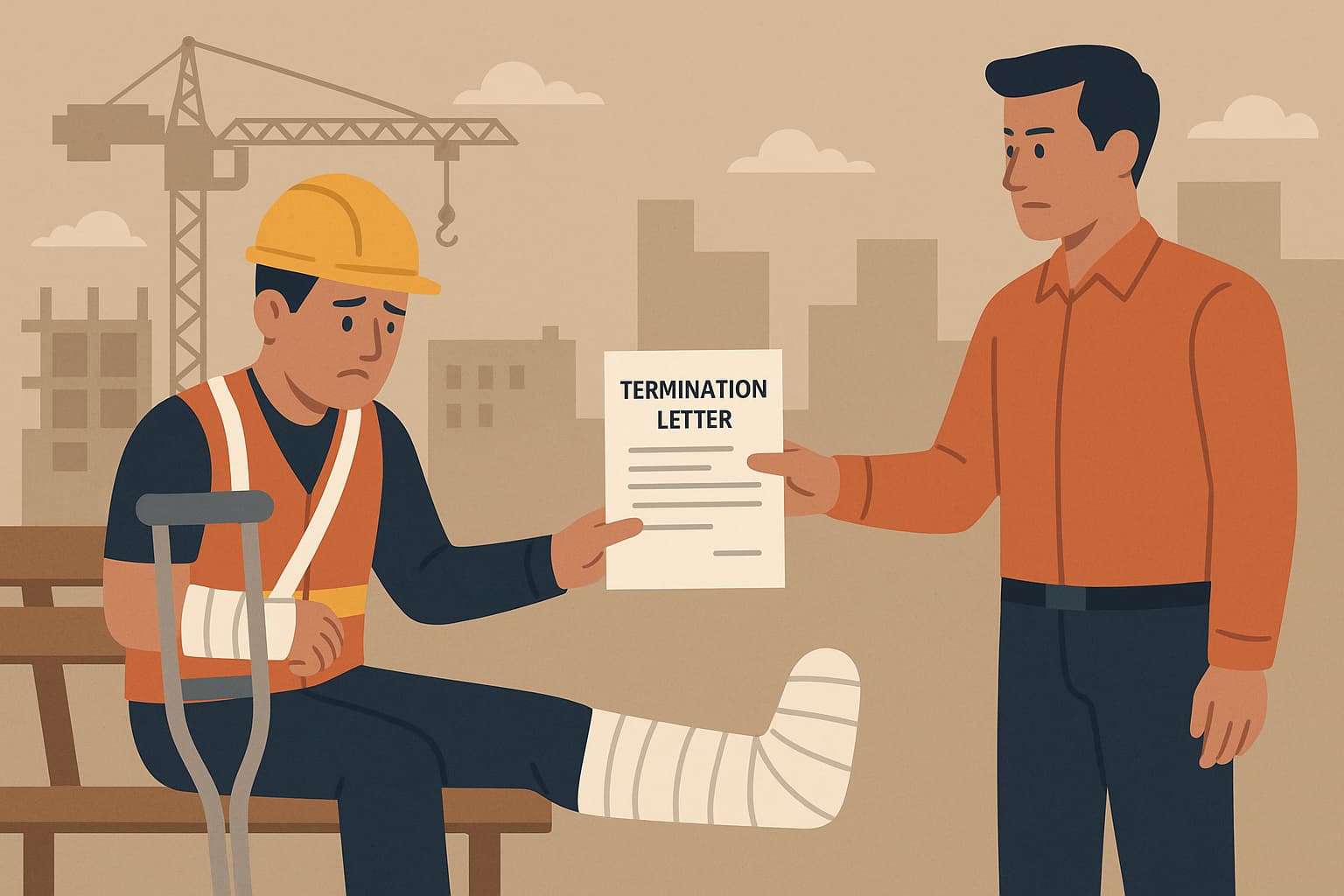
The short answer to whether you can be terminated while on workers’ comp in California is complex: yes, it is possible, but it is illegal for your employer to fire you because you filed a workers’ compensation claim or were injured on the job. California law provides strong protections against this kind of retaliation. Understanding the difference between a lawful termination and an illegal one is crucial for protecting your rights and your future.
If you believe your firing was unfair or retaliatory, consult a California workers’ compensation lawyer today to protect your rights and get the legal help you need.
Schedule a Free Consultation
Key Takeaways about Can You Be Terminated While on Workers’ Comp in California
- California Labor Code Section 132a makes it illegal for an employer to fire or discriminate against an employee for filing a workers’ compensation claim.
- California is an “at-will” employment state, meaning an employer can terminate an employee for a lawful reason, even if that employee is receiving workers’ comp benefits.
- Employers must engage in an “interactive process” to determine if a reasonable accommodation can be made for an injured employee who cannot perform their regular job duties.
- State and federal laws like the California Family Rights Act (CFRA) and the Family and Medical Leave Act (FMLA) may offer additional job protection.
- A termination that occurs shortly after a workplace injury or claim filing may be considered a retaliatory and wrongful act.
- Documenting all communication and events related to the injury, claim, and termination is an important step in protecting one’s rights.
Understanding Your Rights as an Injured Worker in California

When you get hurt at work, your first priority is your health. But close behind is your concern for your job and financial stability. California lawmakers understand this, which is why they created specific rules to protect injured employees. The most important of these is found in the state’s labor laws.
The foundation of your protection is California Labor Code Section 132a. This law makes it illegal for an employer to retaliate against an employee for filing, or even intending to file, a workers’ compensation claim. Retaliation isn’t just about firing someone; it can take many forms.
Some examples of illegal retaliatory actions include:
- Terminating your employment.
- Demoting you to a lower-paying or less desirable position.
- Reducing your work hours or cutting your pay.
- Threatening you with deportation.
- Unfairly disciplining you for minor issues that were previously ignored.
- Transferring you to a difficult location, like a different facility far from your home in Orange County.
These actions are prohibited if the employer’s motive is to punish you for using the workers’ compensation system, a system designed to help you recover.
The Concept of “At-Will” Employment and Its Limits
You may have heard that California is an “at-will” employment state. This generally means that an employer can terminate an employee at any time, for almost any reason, or for no reason at all, without facing legal consequences. Similarly, an employee can quit at any time. However, this “at-will” doctrine has significant limits.
The most critical limitation is that an employer cannot fire you for an illegal reason. Firing an employee as punishment for filing a workers’ comp claim is a clear example of an illegal reason. The challenge often lies in proving the employer’s true motive. An employer will rarely admit they fired someone for filing a claim. Instead, they might offer a different, seemingly legitimate reason, known as a “pretext.”
Here are a few examples of potentially lawful reasons for termination that could occur while you are on workers’ comp leave:
- Company-Wide Layoffs: The company is undergoing major restructuring or downsizing, and your position was eliminated along with many others.
- Business Closure: The entire company, or perhaps just the San Bernardino branch where you worked, is shutting down for financial reasons.
- Prior Performance Issues: You had a well-documented history of poor performance or misconduct that began long before your injury, and the termination is the final step in a progressive disciplinary process.
Even in these situations, the timing and context of the termination are incredibly important. If you are the only one “laid off” right after your injury, it raises serious questions about the employer’s true intentions.
When Your Injury Prevents You from Doing Your Job
What happens if your injury is serious and your doctor says you can’t return to your old job, either temporarily or permanently? This is a common situation for people who suffer catastrophic injuries. Your employer is not necessarily required to hold your exact job open for you indefinitely. However, they are required by law to engage with you in a good-faith discussion to see if they can keep you employed.
This is known as the “interactive process” under California’s Fair Employment and Housing Act (FEHA). The goal is to determine if a “reasonable accommodation” can be made that would allow you to continue working.
The interactive process typically involves these steps:
- Notification: You or your doctor informs your employer about your work restrictions.
- Discussion: You and your employer discuss your limitations and explore potential solutions or accommodations.
- Consideration: The employer must genuinely consider accommodations that do not create an “undue hardship” for the business. Undue hardship means an action requiring significant difficulty or expense.
This collaborative process is a legal requirement, and an employer who refuses to participate may be violating the law.
What is a Reasonable Accommodation?
A reasonable accommodation is a change to the work environment or the way a job is customarily done that allows an individual with a disability to perform the essential functions of that job. For an injured worker, this is a critical pathway back to employment.
Possible reasonable accommodations can include:
- Modified Duties: Temporarily or permanently removing non-essential tasks from your job description that you can no longer perform.
- Light-Duty Position: Offering you a different, less physically demanding job until you have recovered. For example, a construction worker in Anaheim with a back injury might be offered a temporary office role.
- Altered Work Schedule: Allowing for flexible hours or more frequent breaks to manage your condition.
- Specialized Equipment: Providing an ergonomic chair or other tools to help you perform your job without aggravating your injury.
- Leave of Absence: Allowing you additional time off to recover, even beyond other protected leave.
If, after a thorough and good-faith interactive process, it is determined that no reasonable accommodation exists that would allow you to perform any available job without causing the company undue hardship, a termination may be lawful.
The Role of FMLA and CFRA Leave
In addition to workers’ comp and FEHA, injured employees in California may have job protection under two other important laws: the federal Family and Medical Leave Act (FMLA) and the California Family Rights Act (CFRA). These laws provide eligible employees with unpaid, job-protected leave for specific family and medical reasons.
To be eligible, you generally must work for a covered employer and have met certain tenure and hours-worked requirements. If you qualify, these laws offer significant protections.
- Job-Protected Leave: FMLA and CFRA both provide up to 12 weeks of leave per year for a serious health condition that makes you unable to perform your job.
- Concurrent Use: This leave usually runs at the same time as your workers’ compensation leave.
- Right to Reinstatement: When your leave is over, you have the right to be reinstated to your same job or a virtually identical one, with the same pay, benefits, and working conditions.
If an employer terminates you while you are on FMLA or CFRA-protected leave, it is a serious violation. This protection is a powerful tool for injured workers, ensuring they have a job to return to after a period of recovery.
Schedule a Free Consultation
How to Recognize a Potentially Wrongful Termination
Because employers will rarely admit to an illegal motive, you often have to look at the circumstances surrounding your termination. Certain “red flags” can suggest that the stated reason for your dismissal was just a pretext for illegal retaliation.
Consider if any of the following situations apply to your case:
- Suspicious Timing: You were fired within days or weeks of reporting your injury or filing your workers’ comp claim. The closer the termination is to the protected activity, the more suspicious it becomes.
- Inconsistent Explanations: The reason your employer gives you for the termination is vague, keeps changing, or doesn’t make logical sense.
- Excellent Work History: Before your injury, you had a history of positive performance reviews, promotions, and no disciplinary problems. Suddenly, after your injury, the employer claims you are a poor performer.
- Hostile Comments: Supervisors or managers made negative remarks about your injury, your time off, or the cost of your workers’ compensation claim.
- Unequal Treatment: Other employees who were not injured are treated more favorably. For example, in a supposed “layoff,” you are the only employee let go from your department.
These signs don’t automatically prove your termination was illegal, but they strongly indicate that the situation warrants a closer look.
What to Do If You Believe You Were Wrongfully Terminated While on Workers’ Comp in California
If you have been fired and believe it was connected to your work injury, it’s important to act thoughtfully and methodically to protect your rights. While every case is different, here are some general steps you can take.
- Gather Your Documents: Collect all paperwork related to your employment and your injury. This includes your termination letter, past performance reviews, your workers’ compensation claim forms, and any medical notes or work restrictions from your doctor.
- Create a Timeline: Write down a detailed sequence of events. Start from the date of your injury and include when you reported it, when you filed your claim, any conversations you had with your employer, and the date you were terminated.
- Do Not Sign Anything Immediately: If your employer offers you a severance package, do not sign it without understanding what rights you might be giving up. These agreements often include a clause releasing the company from all future legal claims.
- Seek Professional Guidance: The laws surrounding workers’ compensation, disability, and employment are complex and overlap in many ways. Consulting with a legal professional can help you understand your specific situation and what options may be available to you.
Taking these steps can help preserve your ability to hold an employer accountable if your rights were violated.
FAQs: Terminated While on Workers’ Comp in California
Here are answers to some common questions people have about their job security after a workplace injury.
Can my employer replace me while I am out on leave?
Yes, an employer can hire a temporary worker to cover your duties while you are recovering. However, if you are on protected leave like FMLA/CFRA, they must reinstate you to your original or an equivalent position upon your return. Hiring a permanent replacement for your specific role while you are on protected leave could be a violation of the law.
What if my old job doesn’t exist anymore when I’m ready to return?
If your position was legitimately eliminated due to a company-wide layoff or restructuring that would have happened regardless of your injury, the employer may not be required to reinstate you. However, they cannot use a fake “restructuring” as an excuse to get rid of an injured worker. You may still be entitled to placement in another available position you are qualified for.
Does my employer have to offer me a light-duty position?
An employer is not automatically required to create a new light-duty position if one does not exist. However, as part of the reasonable accommodation interactive process, they must consider offering you any existing, vacant light-duty positions that you are qualified to perform.
Can I be fired for violating a company safety policy that led to my injury?
This can be a gray area. If you have a clear history of violating a consistently enforced safety rule, and the violation was serious, an employer might argue the termination was for misconduct, not the injury itself. However, if the rule is minor or not enforced with other employees, using it as a reason for termination right after you file a claim could be seen as a pretext for retaliation.
Let Us Help Tell Your Story
Dealing with a serious injury is difficult enough without the added stress of losing your job. If you were terminated while on workers’ comp in California, you may feel uncertain about your future and your rights. The legal landscape is complicated, but you do not have to find your way through it by yourself.
The attorneys at Bentley & More LLP are dedicated to advocating for injured workers and consumers throughout Southern California. We have extensive experience handling complex workers’ compensation claims and cases involving wrongful termination. Our team understands how to investigate the circumstances of a job loss to determine if an employer acted unlawfully.
If you believe you were fired in retaliation for a work injury in Orange County, Riverside, San Bernardino, or anywhere in Southern California, contact Bentley & More LLP today at (949) 870-3800 or through our online form for a free, confidential consultation.
Schedule a Free Consultation
About the author: Keith More
Co-Founder & Trial Lawyer at Bentley & More LLP
Keith P. More is Co-Founder of Bentley & More LLP in Newport Beach, California. With 37 years of experience, he represents injured workers in California workers’ compensation cases, including catastrophic injury claims. A four-time Orange County Trial Lawyers Association Workers’ Compensation Trial Lawyer of the Year, he obtained a $14.7 million settlement for a tetraplegic client, which the firm describes as the largest in California workers’ compensation history. Keith earned his J.D. with honors from DePaul University College of Law.








 ES
ES