Home » Blog » Who Is at Fault in a Car Accident Changing Lanes in California?
|
|
Last Modified on May 05, 2026
Determining who is at fault in a car accident while changing lanes in California usually starts with the driver who made the move. In most situations, the driver who changes lanes has a legal responsibility to make sure the path is clear and it is safe to proceed. However, California law recognizes that fault is not always absolute, and other factors, such as the speed or attentiveness of the other driver, can play a significant role in the final determination.
Understanding the specific traffic laws and the concept of negligence is key to sorting out liability. While the lane-changing driver is often found to be the primary cause, a thorough investigation may reveal that responsibility is shared. The details of the incident, supported by strong evidence, will ultimately tell the story of what happened and who should be held accountable.
Speak with a car accident lawyer today to understand your rights and get guidance on your next steps.
Schedule a Free Consultation
Key Takeaways about Fault in a Changing Lanes Car Accident in California
- Establishing fault in a lane change collision depends on which driver had the right-of-way and which driver acted without reasonable care.
- California Vehicle Code 22107 mandates that a driver must confirm a lane change is safe before initiating the maneuver.
- Evidence such as police reports, witness accounts, and dashcam footage is fundamental in proving liability in these types of accidents.
- Under California’s pure comparative negligence rule, multiple drivers can be assigned a percentage of fault for a single accident.
- The location of the vehicle damage can provide important clues about the sequence of events leading up to the collision.
Understanding California’s Lane Change Laws

In California, the rules of the road are designed to create a predictable and safe environment for everyone. When it comes to changing lanes, the law is very specific. Every driver on the road has a fundamental “duty of care,” which is a legal term for the responsibility to act with reasonable caution to avoid harming others. This duty is at the heart of determining fault in a car accident.
The primary law governing lane changes is California Vehicle Code 22107. This statute states that no person shall turn a vehicle or move right or left upon a roadway until the movement can be made with reasonable safety and after giving an appropriate signal.
So, what does “reasonable safety” mean in practical terms? It involves a series of checks and actions that a careful driver should take before ever starting to move into another lane.
- Activate Your Turn Signal: You must signal your intention to change lanes for a reasonable distance before making the move. This alerts other drivers to your plans.
- Check All Mirrors: This includes your rearview mirror and both side-view mirrors to get a comprehensive picture of the traffic around you.
- Look Over Your Shoulder: Mirrors alone are not enough. Every vehicle has blind spots—areas around the car that cannot be seen in the mirrors. A physical head turn is necessary to check these areas for other vehicles, motorcyclists, or bicyclists.
- Assess Traffic Speed and Space: You must judge the speed of the traffic in the lane you wish to enter and ensure there is a large enough gap to move into without forcing the driver behind you to brake suddenly.
Completing these steps is not just good driving advice; it is a legal requirement. When a driver fails to follow these procedures and causes a collision, they have likely breached their duty of care.
How Is Fault Determined in a Car Accident Changing Lanes in California?
When legal professionals and insurance companies investigate a car accident, they look for evidence of negligence. Negligence is a legal concept that means someone failed to use reasonable care, and that failure resulted in harm to another person. To prove negligence, one must show that the at-fault driver had a duty, breached that duty, and that this breach caused the accident and resulting injuries.
In the context of a lane change, violating Vehicle Code 22107 can be considered negligence per se. This is a legal doctrine that essentially says that if someone violates a safety law (like a traffic law) and causes the type of harm the law was designed to prevent, their actions are presumed to be negligent. Because the lane change law exists to prevent collisions, a driver who causes a crash by making an unsafe lane change is often presumed to be at fault.
Common examples of negligent lane changes include:
- Failing to Signal: The driver moves into another lane without warning other motorists.
- Not Checking the Blind Spot: The driver relies only on their mirrors and merges into a car that was hidden in their blind spot.
- Misjudging Speed or Distance: The driver cuts off another vehicle, not leaving them enough time or space to react safely.
- Changing Multiple Lanes at Once: A driver quickly cuts across several lanes of traffic, for example, to get to an exit on the 405 freeway.
- Changing Lanes in an Intersection: This is generally prohibited and creates a dangerous and unpredictable situation for all drivers.
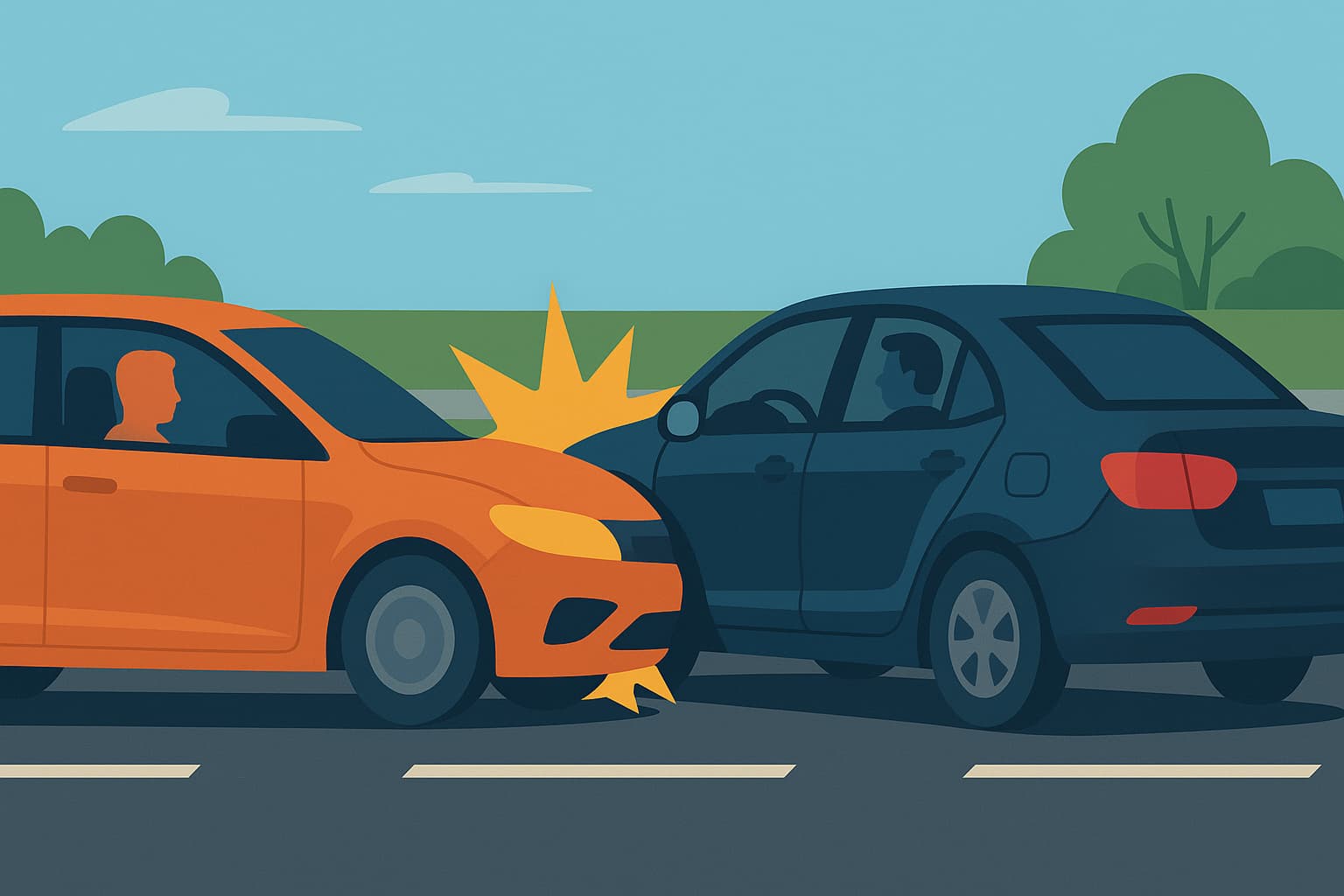
The physical evidence often helps reconstruct the accident. For instance, damage to the front of one car and the rear side panel of another often suggests the second car changed lanes in front of the first. An accident reconstructionist can analyze skid marks, vehicle damage, and debris fields to help establish the sequence of events and pinpoint the negligent actions that led to the crash.
What if Both Drivers Share Fault? California’s Pure Comparative Negligence Rule
Sometimes, a lane change accident isn’t entirely one person’s fault. You might have made an unsafe lane change, but what if the other driver was texting or speeding? California law accounts for these complex situations with a rule called pure comparative negligence.
This rule means that an injured person’s compensation can be reduced by their own percentage of fault. In simple terms, you can still recover damages even if you were partially to blame for the accident.
Let’s look at an example. Suppose a driver merges into your lane without signaling, causing a collision. However, it’s determined that you were driving 15 mph over the speed limit. A court might decide that the other driver was 80% at fault for the unsafe lane change, but you were 20% at fault for speeding, which reduced your ability to avoid the crash. If your total damages were $100,000, your final award would be reduced by your 20% of fault, meaning you could recover $80,000.
Here are a few scenarios where comparative negligence often applies in lane change accidents:
- Speeding: A driver in the adjacent lane is traveling well above the speed limit, making it difficult for the merging driver to judge a safe gap.
- Distracted Driving: The driver who was hit was looking at their phone or was otherwise not paying attention to the road and failed to take reasonable evasive action.
- Simultaneous Lane Changes: Two drivers in outer lanes both try to merge into the center lane at the same time, leading to a sideswipe.
- Broken Taillights or Headlights: If the non-merging vehicle had malfunctioning lights at night, it could be partially responsible for not being visible.
Because fault can be divided, it is important not to assume the outcome of your case. An insurance adjuster may try to place an unfair amount of blame on you to reduce their payout. Documenting all factors of the accident is essential to protect your rights and ensure liability is assigned fairly.
Schedule a Free Consultation
Critical Evidence to Gather After a Lane Change Collision
The moments after a car accident can be disorienting. Once you have received any necessary medical attention and are safely home, the information you gather can become the foundation of your injury claim. Strong evidence is crucial for demonstrating how the other party was at fault for the car accident.
If possible, try to collect and preserve the following items:
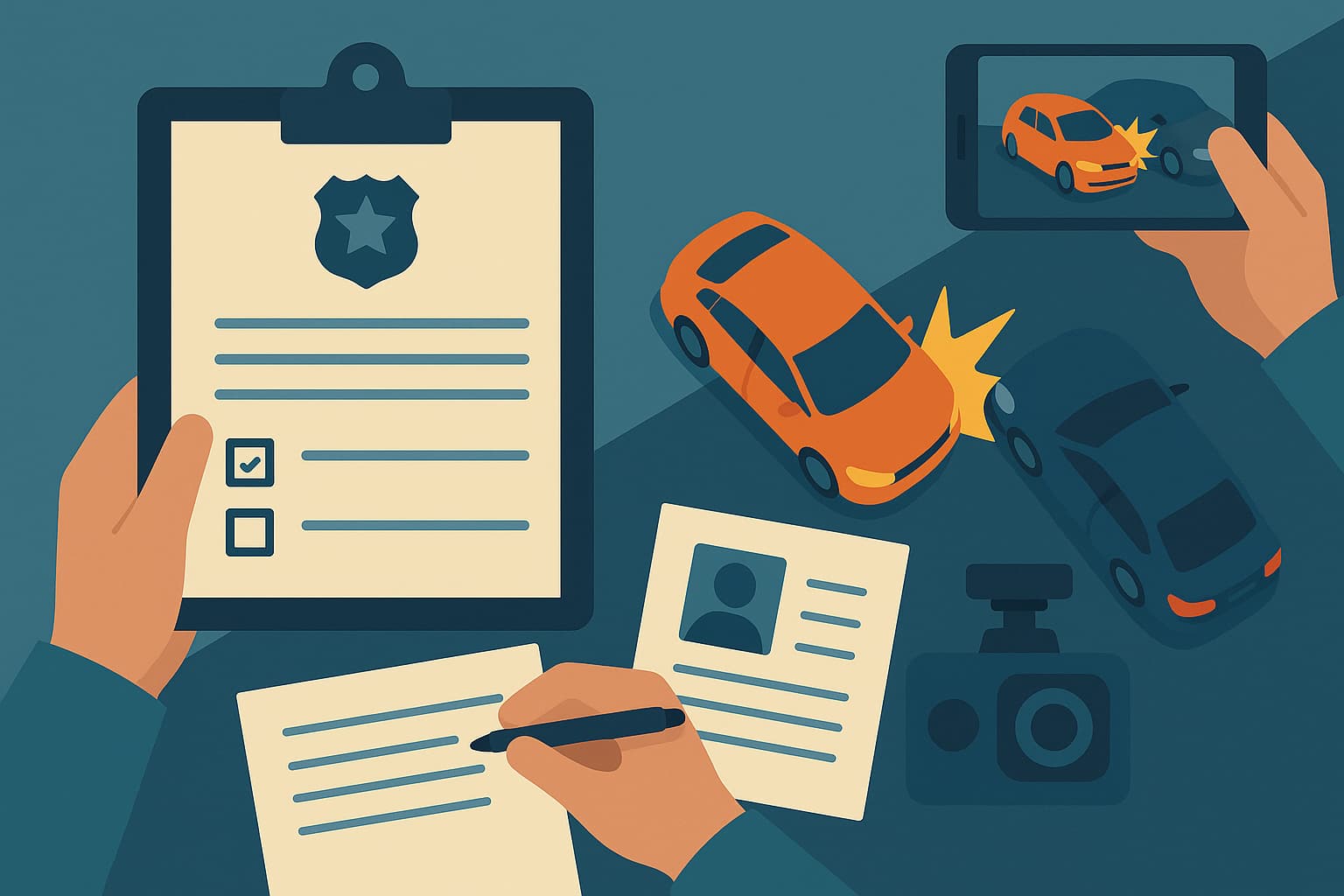
- The Official Police Report: If law enforcement responded to the scene, they created a report. This document contains the officer’s initial observations, statements from drivers and witnesses, a diagram of the accident scene, and sometimes, a preliminary assessment of fault. You can typically request a copy from the police department that responded, whether it was the CHP, the Irvine Police Department, or another local agency.
- Photographs and Videos: Your smartphone is a powerful tool. Take pictures of everything you can from multiple angles. This includes the damage to all vehicles involved, their final resting positions, any skid marks on the road, traffic signals or signs, and the weather and road conditions at the time.
- Witness Contact Information: Independent witnesses can provide an unbiased account of what happened. If anyone stopped to help or saw the crash, get their name and phone number. Their testimony can be invaluable in countering a false narrative from the other driver.
- Your Written Account: As soon as you are able, write down everything you remember about the accident. Memories can fade, so documenting the details is important. Describe the moments leading up to the crash, what you saw and heard, and any conversations you had with the other driver.
- Dashcam Footage: If your vehicle is equipped with a dashcam, save the footage immediately. This can provide indisputable proof of an unsafe lane change. Also, ask nearby businesses or residents if they might have security camera footage that captured the incident.
This collection of evidence helps build a clear and compelling story of the events. It allows you to counter any attempts by the other driver or their insurance company to shift blame and misrepresent what truly occurred.
Why Insurance Companies Complicate Lane Change Accident Claims
After a collision, you will likely have to deal with the at-fault driver’s insurance company. It’s important to remember that while an insurance adjuster may seem friendly and helpful, their primary role is to protect their company’s financial interests. This means their goal is often to resolve your claim for the lowest possible amount.
Insurance companies may use various tactics to minimize what they have to pay. They might try to get you to provide a recorded statement shortly after the accident, hoping you will say something they can use against you later, such as admitting partial fault or downplaying your injuries. They may also make a quick settlement offer that seems tempting but is far less than what your claim is actually worth, especially if you have serious injuries that require long-term medical care.
In a lane change accident, the adjuster may work hard to argue that you were partially at fault. They could claim you were speeding, distracted, or in the other driver’s blind spot, even without evidence. By shifting even a small percentage of the blame to you, they can reduce the value of your claim under California’s comparative negligence rules. Dealing with these tactics while trying to recover from injuries can be a difficult challenge.
FAQs: Who Is at Fault in a Car Accident Changing Lanes in California?
Here are answers to some common questions about determining liability in lane change collisions.
What if a driver was in my blind spot when I changed lanes?
In California, the legal responsibility falls on the driver making the lane change to ensure the lane is clear. This includes checking blind spots. While it is an unfortunate situation, moving into a lane occupied by another vehicle, even if it was in your blind spot, will generally place the fault on you.
Does the point of impact on the cars matter in a lane change accident?
Yes, the location of the damage is often a key piece of evidence. For example, if the front of one car hits the rear side panel of another car, it typically indicates that the second car moved into the first car’s lane. An accident reconstructionist can use this information to help determine the sequence of events.
Is changing lanes in an intersection illegal in California?
While there isn’t a specific law that explicitly forbids changing lanes in an intersection, it is generally considered an unsafe maneuver and can be grounds for a traffic citation. A driver who changes lanes in an intersection and causes a crash will very likely be found at fault for making an unsafe movement.
How long do I have to file a claim for a car accident in California?
In California, the statute of limitations for filing a personal injury lawsuit is generally two years from the date of the injury. For property damage claims, the limit is typically three years. It is important to be aware of these deadlines, as missing them can prevent you from ever recovering compensation.
What types of compensation can be recovered after a lane change accident?
An injured person may be able to recover compensation for a variety of losses, often called “damages.” This can include the costs of all past and future medical treatment, lost wages from being unable to work, loss of future earning capacity, property damage to your vehicle, and non-economic damages for pain, suffering, and emotional distress.
Let Us Help Tell Your Story
A serious car accident can leave you with physical pain, financial strain, and many unanswered questions. If you or a loved one has been injured in a complex lane change accident in Southern California, you need an advocate who can stand up for your rights and present the facts clearly and powerfully. The attorneys at Bentley & More LLP are dedicated to fighting for people who have suffered serious injuries and are prepared to take on difficult cases that require deep investigation and litigation.
We focus on understanding your individual experience so we can tell your story effectively. Our goal is to secure the resources you need to rebuild your life and move forward. Contact Bentley & More LLP today at (949) 870-3800 or through our online form for a free, confidential consultation with our team of personal injury lawyers.
Schedule a Free Consultation
About the author: Greg Bentley
Co-Founder & Trial Lawyer at Bentley & More LLP
Greg Bentley is Co-Founder of Bentley & More LLP in Newport Beach, California. With 36 years of experience, he represents plaintiffs in personal injury, wrongful death, product liability, insurance bad faith, dangerous road and property conditions, and construction-site failure cases. Admitted to the State Bar of California, Greg earned his J.D. from Western State University College of Law in 1990. He is a member of several invitation-only trial organizations, including the American College of Trial Lawyers and the International Academy of Trial Lawyers, and is active in multiple statewide and regional trial lawyer associations.







 ES
ES